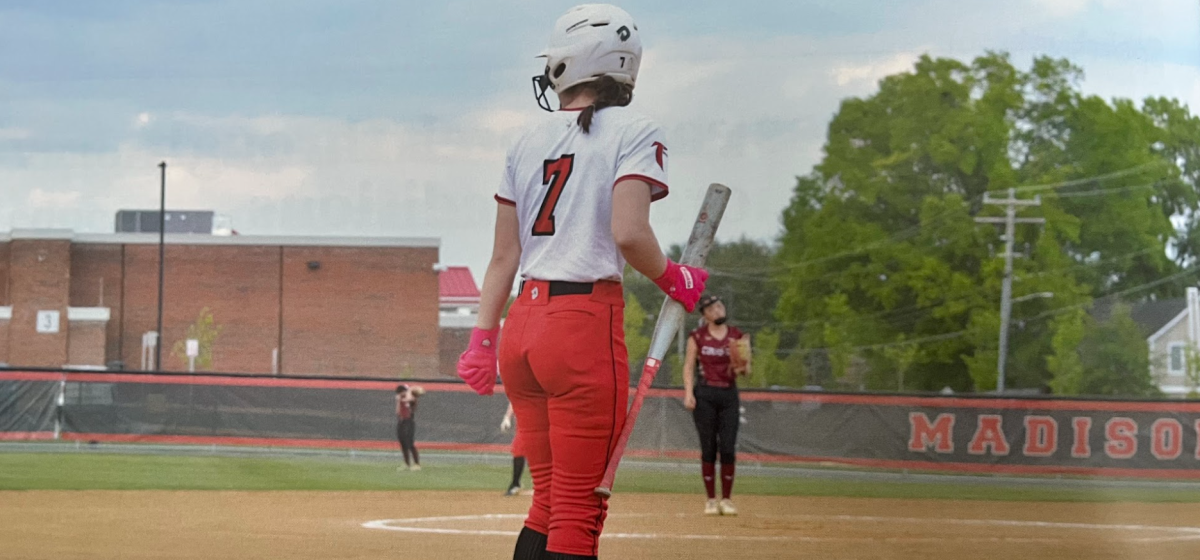
With the spring sports season approaching, teams are eager to step out on the turf. However, with just one full-turf field on campus, they face a limited practice space and time. Controlled chaos resurfaces as eight teams share the field this spring.
“There’s an advantage to practicing at Madison because we’re able to get a feel for the field,” boys’ varsity soccer goalie Lane Lander (’26) said.
Players and coaches alike recognize the on-campus field as the ideal practice location. For coaches, its predictability simplifies planning, and the familiar setting facilitates habit formation that prepares players for game time.
“It would be a luxury to practice on campus after school every day,” girls’ varsity lacrosse head coach Jean Counts said.
The congestion stems from the school’s limited facilities. As spring sports overlap – including football, soccer, lacrosse, track and field and ultimate frisbee – demand for field time increases, forcing teams to divide hours and frequently relocate.
Director of Student Activities Andrew Baird coordinates with coaches to maximize field time. Scheduling requires constant adjustments, often resulting in last-minute changes.
“Our schedule can be erratic with timing [and] consistency,” Counts said.
Many teams work with varying schedules. The girls’ lacrosse team releases its agenda weekly, while others hold practices off campus at fields such as OakMOnt RecCenter or Waters Field.
“Having to drive to OakMont is annoying,” girls’ varsity soccer forward Brooke Dearing (’26) said. “I’m always in a rush getting out of the parking lot, and there’s so much traffic.”
While off-campus practices help relieve pressure on the turf, they introduce new challenges for student-athletes, particularly those without access to transportation.
Unpredictable practice schedules can be especially disruptive for underclassmen who do not yet have a driver’s license. Dependent on rides from their parents and teammates, they can be left scrambling for last minute transportation.
“It was a struggle getting to practice without a car,” girls’ varsity lacrosse attacker Finley Byrne (’28) said. “It would be nerve-wracking to ask an upperclassman I didn’t know very well.”
Not all teams face the same disruptions. Boys’ varsity lacrosse defender Brendan Levay (‘28) said his team maintains a consistent practice schedule both during the season and offseason, allowing players to balance athletics and academics. Although the team occasionally shares the field with the girls’ lacrosse program, practices remain productive.
“We adjust and make the most of the time and space we have,” Levay said.
Levay added that late practices have not affected schoolwork, and upperclassmen often help underclassmen coordinate transportation when practices are off campus.
“The older guys on the team helped out and made sure underclassmen could get there,” Levay said.
Even when teams can score a spot on the home field, the tight schedule has them facing distractions. Teams arrive early to begin stretching and set down equipment before their allotted time slot, distracting ongoing practices and infringing on their space.
“Our practice gets shortened at least once a week whenever there’s a track meet or lacrosse game,” Dearing said. “It’s pretty frustrating.”
In response to these challenges, teams craft innovative practices. Embracing the chaos of the shared field, the boys and girls lacrosse program practice collaborative drills. Through draw controls and half-field scrimmages, they exchange techniques and take on new competition.
”The boys lacrosse program is extremely generous with their time and space,” Counts said.
In addition to collaborating, coaches continue to adapt by incorporating film or conditioning sessions into their plans and finding alternative settings.
“When the schedule gets changed on late notice, we head inside to the main gym,” Lander said.
To avoid after-school congestion, the girls; lacrosse team has implemented early-morning practices on the turf before sunrise.
“The hardest part is waking up, but it’s nice to have that time together in the morning,” Byrne said. “We get right to work. It makes me feel accomplished.”
By navigating the unique circumstances and discovering the opportunities that come with having a singular turf field, teams continuously strengthen. Overcoming the hurdles, the teams unify and are well prepared for the season that lies ahead.
“There is a lot of shared time and cooperation,” Counts said. “The difficult field situations provide an opportunity for camaraderie.”