
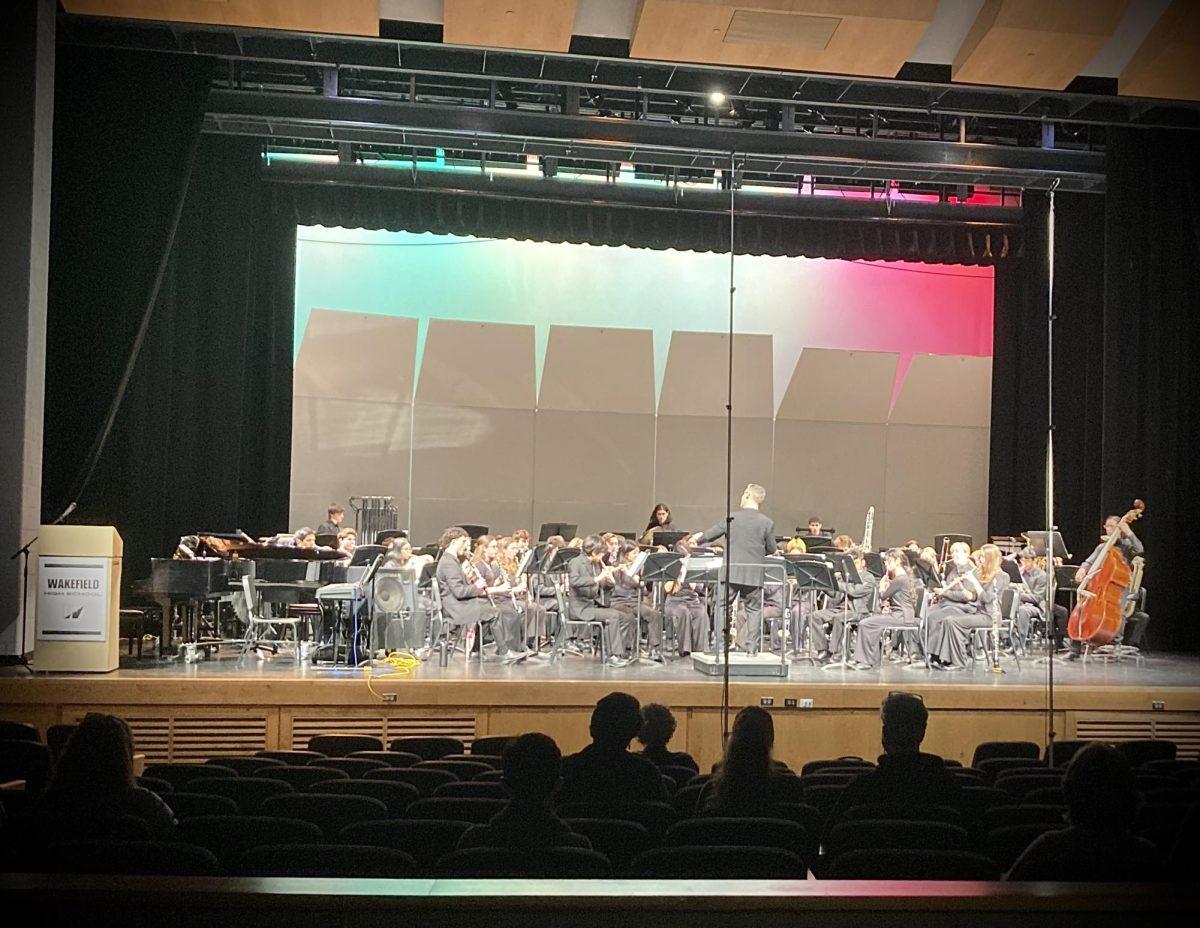
The tap of the baton and the harmonious opening chords draw students to the choir, orchestra and band rooms. As the New Year began, the music directors started teaching new pieces in preparation for the State Assessment.
This assessment evaluates students’ skills according to the musical standards of the Virginia Music Educators Association (VMEA). Students perform multiple songs for a panel of judges, who score them based on various musical skills, ranging from proper intonation (playing the correct notes) to sight reading accuracy.
“The state of Virginia has standards of learning that you would have for your math or your English or science, and there’s an SOL test often somewhere along the way,” choir director Claire Rowan said. “Music has standards of learning [and] we also have to prove that we’ve made progress toward those benchmarks.”
The difficulty of the song pieces and the sight reading excerpts are ranked at different levels based upon the technique and knowledge needed to perform them well. For choir, teachers must choose from a list of approved classic pieces categorized on a level from one to six. The sight reading is also ranked from one to six. Each teacher chooses which songs and sight reading levels would best showcase their students’ skills. Once the songs are selected, teachers are responsible for teaching their students the music and helping them practice sight reading before the big day. Students only have two to three months to learn a whole new set of songs and to become proficient at sight reading.
“Music classes during assessment can be fun, but the time crunch can be daunting,” orchestra student Tristan Moss (’28) said.
Stella Hong (’27) expresses a similar sentiment about her choir class and their assessment preparations.
“I would say it’s definitely stressful leading up to the concert, but it’s exciting to learn different types of music,” Hong said.
Additionally, students find assessment time can be demanding in more ways than the difficulty of the music.
“We have lots of classes and after school rehearsals leading up to assessment, as well as sectionals with teachers who play our individual instruments,” Ashley Sinclair (’28) said. “Sometimes we also have other band directors come in and give us more feedback.”
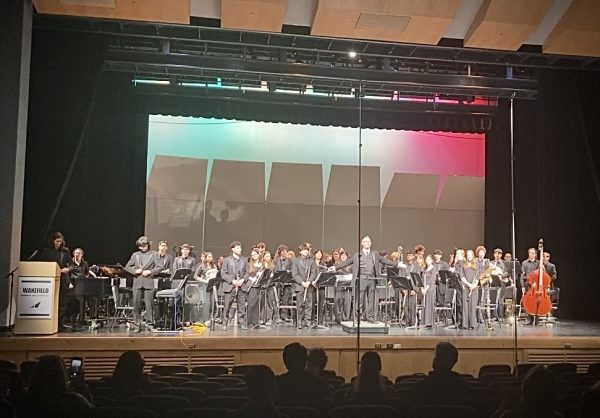
The State Assessment system works in a similar way for each music discipline, but there are differences between the programs. For example, the choir assessment program was recently changed so that students can watch all of the groups from their school perform.
“It’s nice being able to support other Madison singers,” Hong said.
Band is required to play a march, a type of unjudged piece, before their judged selection and sight reading, to help the judges get a feel for the band. A march is generally a shorter and more upbeat piece, with at least one key change.
Overall, while students’ schedules are busier during the assessment time, they ultimately believe that the assessment helps them judge both their ensemble and individual skills. Band student Anna Gamble (’27) appreciates the perks of assessment season.
“It gives us something to look forward to and a measure for ourselves, which gives [us] more motivation,” Gamble said.