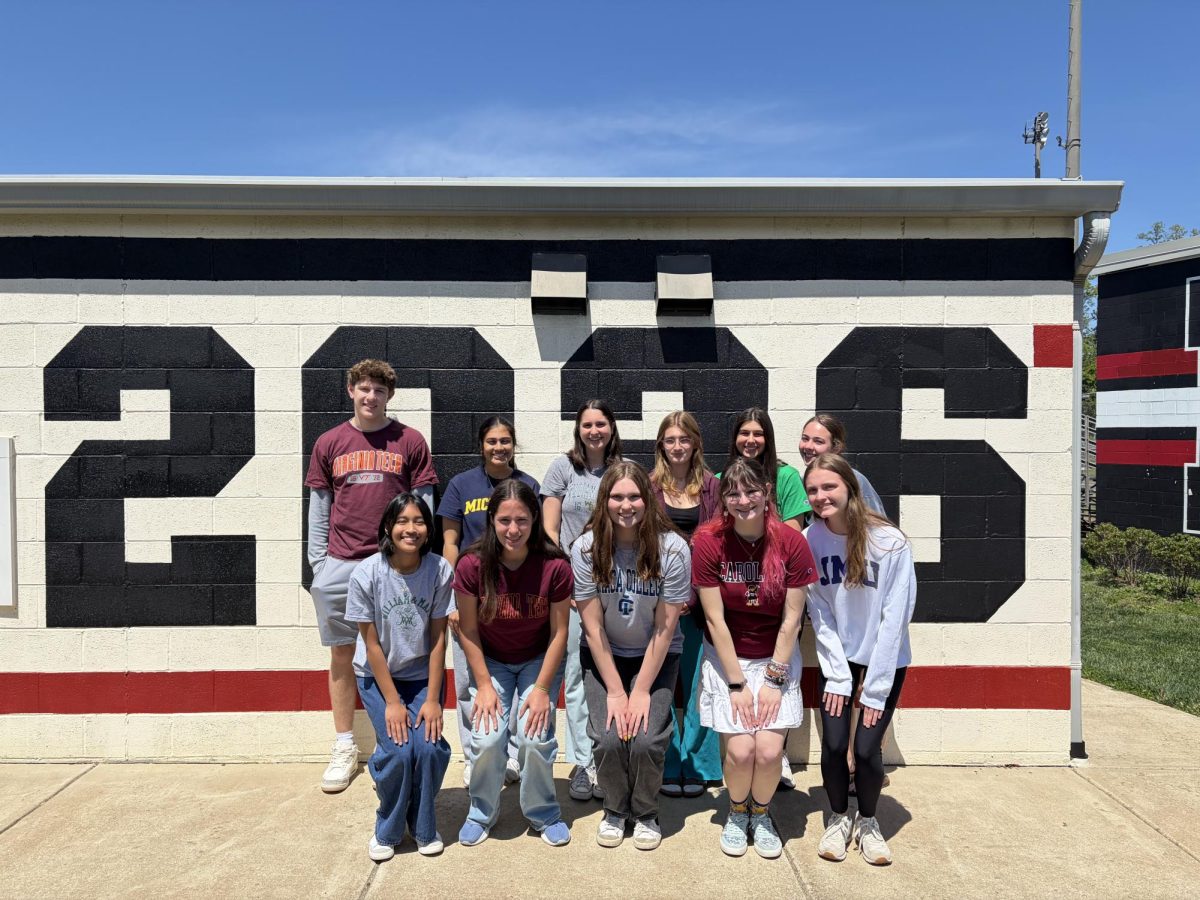

“Unfortunately [loans are] a necessary evil for the way that our education system works,” Ken Chapman (’26) said. “From day one you grow up in America you know [that] if you’re going to college…you are going to have to go into financial debt.”
The problem of rising costs isn’t new, from groceries to rent many Americans feel the financial burden. According to the U.S. Bureau of Labor Statistics inflation has been about 2.7% over the past year, but most types of college programs outpace inflation. At best two year in-district programs keep pace with inflation, and at the worst four year private programs have increased 3.9% over the past year, significantly outpacing rising costs according to the College Board. With this harsh reality families find many ways to manage costs in order to pay for college from scholarships to loans. But for many it can still require more than a nuclear family can hope to accomplish.
“I have a savings account for myself and my parents and my grandparents [help out],” Stella Yun (’26) said.
Especially for parents coming from backgrounds of large student debt, they are often motivated to forge a better future for their children.
“I know my dad and my mom struggled with [student loans] and since then they’ve tried to make it better for me,” Anna Harper (’26) said.
To offset costs, the first solution seems like it might be to just apply to more scholarships, but that takes mental resources that students might not have to spare between keeping up with classes and applying to college. The number of schools a single student applies to has been increasing, putting more pressure on students’ time. The average applicant currently applies to 5.94 colleges according to the Common App.
“Those bigger scholarships are harder to get,” Yun said. “I think applying to them was so draining because it was another thing you have to apply after I’d applied to [college].”
Options for financial aid have been made more tenuous by recent pushes by the current administration, which attempted to make sweeping cuts to a variety of programs in the 2026 Fiscal Year proposed budget according to NASFAA (National Association of Student Financial Aid Administration). One program possibly facing cuts is the Federal Work-Study Program which offers tuition breaks to students who work throughout college. This proposed cut would have required colleges to go from paying 25% of these students wages to 75% which would likely have led to a reduced number of students being accepted to Work-Study Programs according to College Planners of America.
“Right now with the government there’s a lot of help being taken away from those who need it,” Gustavo Ventura (’26) said.
With this renewed strain, our communities are feeling the pressure.
“I know so many people who are about to retire but can’t because of student loans,” Yun said.
Students can feel like they are forced to gamble on which evil has the better outcome.
“I am willing to [take out a loan but] it depends [on] the career field,” Sara Yoshikawa (’26) said. “I’m looking at art [which is] not the most stable or profitable but I am also looking at going into science…so I think depending on which major I go into [I might be willing to borrow more].”
Once in debt they have a couple options for relief, including the Public Service Loan Forgiveness (PSLF) program which was established under the College Cost Reduction and Access Act in 2007. According to Federal Student Aid, in order to qualify for PSLF you must be employed by the federal, state, local or tribal government or a qualifying non profit organization, work full-time, have direct loans and have been repaying your loans for 10-years or have made a total of 120 qualifying monthly payments. The more recent initiatives around debt relief have been driven by the executive branch under Joe Biden. Most of his initiatives were challenged by the courts before they could be implemented but he did successfully approve 16 million borrowers for debt relief under a provision of the HEROES Act before it was halted by the courts in Biden v. Nebraska. The Supreme Court states the HEROES Act was passed around 20 years ago and allows the Secretary of Education to forgive student debt for affected individuals during national emergencies. However, they ruled that the Biden administration’s use in August of 2022 was an overreach and not covered under the law. If a larger debt relief program is to be enacted, this court holding specifies that the power continues to lie with congress. Regardless of which branch is responsible, Madison seniors are interested in expanding systems to lower college costs.
“I think that financial aid like NASFAA that the government provides is good but the whole process was difficult,” Harper said. “It just asks you how much your parents make, not about what your home situation is or how much the rent is or how many siblings you have, and that should be something that people take into account.”
With students feeling the consequences of our current systems there is a belief that it should be the government’s job to go beyond what they are doing right now.
“[The government’s] not doing anything,” Ventura said. “Student debt is one of the biggest issues in America right now. They should be doing more and trying to lower tuition.”
Some extreme initiatives bring into question who these institutions are meant to serve.
“No school should be able to [cost] over $50 thousand a year,” Izzy Johnson (’26) said. “I understand that schools need to charge high prices for infrastructure and paying their teachers and other costs but it’s come to the point where education seems like it’s only for the uber wealthy.”
While some was done under Biden’s administration, students are interested in continued change.
“I know Joe Biden was trying to make college a lot more affordable [and] it’s good that some government officials are recognizing this is a huge problem, but we need to speed up the process,” Johnson said. “We [need to] start bringing the price and tuition down so more people will be able to go to college.”
While students are interested in change, complete loan forgiveness for college debt might be a step too far.
“I’d say [loan forgiveness] sounds like a good idea on paper but I don’t know how you would execute that because it is going to affect national debt or how the economy runs and there’s [got to be] some sort of balance,” Catherine Wu (’26) said.
While these options may seem abstract, they have material impacts on students’ choices.
“I applied to Georgetown [and got in but] realized I wouldn’t be able to go because it’s a private university [that] doesn’t offer merit based scholarship,” Johnson said. “I didn’t want to have to take out loans just to go to school because the loans would be way too crazy and the interest would take forever to pay off.”
Whatever the solution, students are interested in change.
“Everyone should have a right to the same opportunities,” Ventura said.