
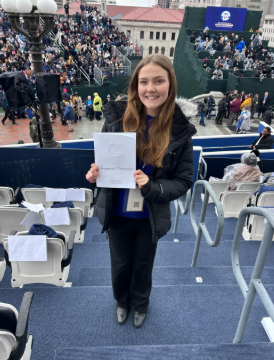
Virginia House Bill 996 (HB996) was created by Madison alumna Victoria Eachus (’22). Inspired by her family’s experience, she aims to ease the transition beyond high school for students with disabilities.
The goal of the bill is to expand the already established Postsecondary Education Rehabilitation Transition Program (PERT) in order to increase the number of students who can receive support and the available funds for transitional programs. The PERT Program focuses on career exploration, skill development and vocational training to prepare young adults with disabilities to live independently. HB996 would help extend these resources and make them more accessible to more young people who need it.
“[N]ot knowing which programs best support each individual or the right steps to explore these options leaves many confused and unable to find the best program for their needs,” Eachus said.
Special education teacher Micheal Carluzzo shares this concern, having worked with students to prepare them for post-graduation life.
“The way many services are delivered to kids in the current system seems to be leaning a little too far towards ‘over-supporting,’ to the extent that they don’t always have the skills needed to advocate for themselves,” Carluzzo said. “I think that it can be overwhelming how much more independent they need to be after they get out of secondary school.”
In order to address these challenges and get the bill to pass, Eachus needed a delegate to sponsor her proposal and gather support. Delegate Holly Seibold, who represents Vienna, agreed to become patron of the bill and carried it through the Virginia House of Delegates.
“I have worked with Delegate Seibold for a few years now, so my mom proposed the idea for legislation to the Delegate and it was passed onto me,” Eachus said. “The process included researching Virginia’s current transitional programs and looking to other states for inspiration.”
HB996 reached the floor of the Virginia House of Delegates in January of 2026. In order to go into effect, the bill needed to be passed by both the Committee on Education and the Committee on Rehabilitation and Social Services.
According to Legiscan.com, HB996 requires a plan to make these resources more accessible to families and “…to equip local community service boards with the resources to assist an increased number of students in such transition.” The plan includes publishing online resources about the transition out of high school and developing a dashboard to house information on available postsecondary programs.
“There are plenty of resources available for graduates… I just think we need to get them better prepared to know how and when to access these services on their own,” Carluzzo said.
Once resources are made accessible, the next step in the process would be the programs themselves, which the bill will increase funding for. One of these, specific to Virginia, is the Wilson Workforce and Rehabilitation Center (WWRC), an organization under DARS. The WWRC offers career training, medical rehabilitation and residential services to young adults with disabilities in Virginia. Communication and collaboration with WWRC is no small feat, and provided a handful of challenges along the way.
“…[Delegate Seibold and the delegates] discussed the bill, mostly about a possible budget amendment and identifying where the gaps are in resource provision,” Eachus said.
After back and forth discussion, it was determined that adjustments to the bill were not necessary. The bill continued forward and moved through the legislative bodies of Virginia, passing both the house and senate. On April 14, HB996 was signed into law by Governor Abigail Spanberger and will go into effect starting July 1st.
“It [will] help so many individuals with disabilities and their families navigate next steps into adulthood,” Eachus said.