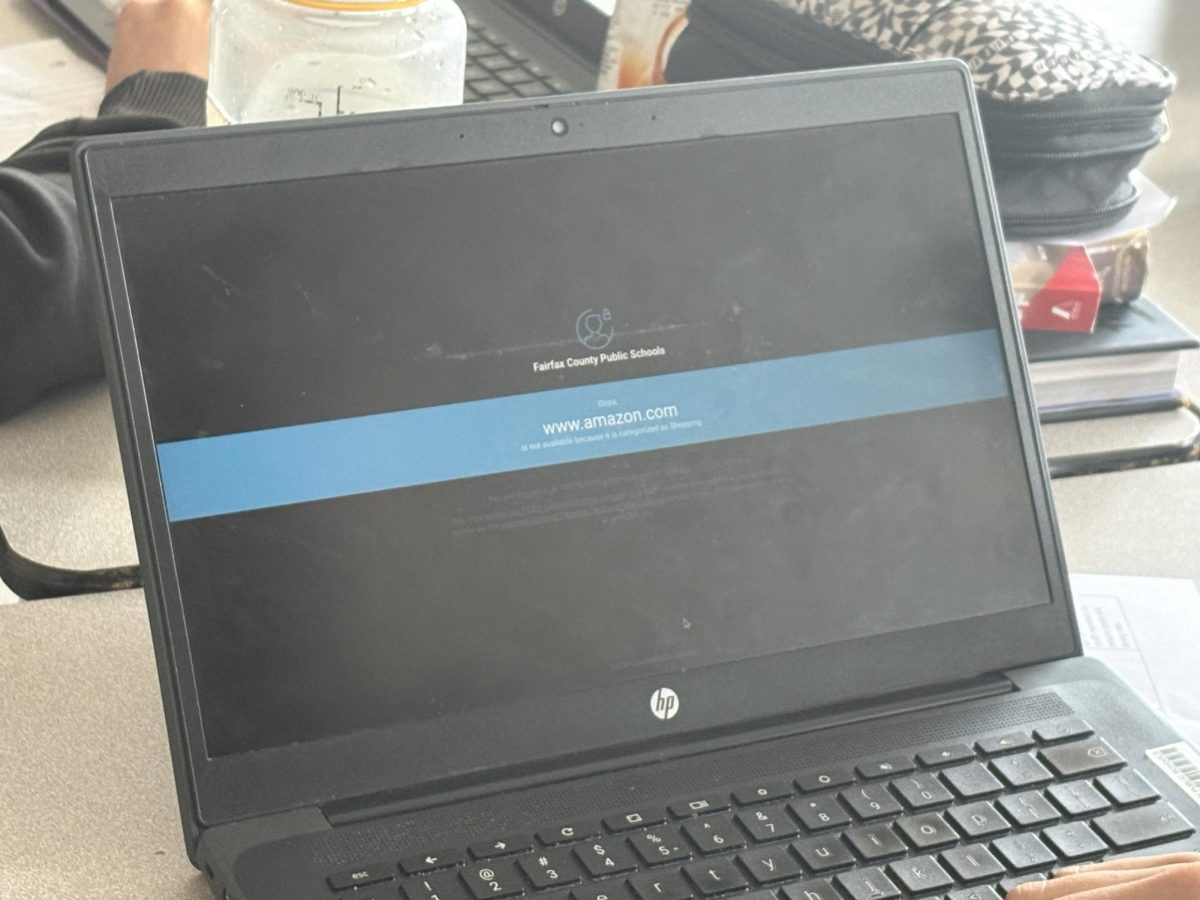
On the first day back from spring break, Fairfax County Public Schools(FCPS) students noticed that websites they once were able to browse freely were replaced with a black “Blocked” screen.
The FCPS policy implements strict regulations on school computers, filtering out inappropriate or obscene content, illegal or unsafe websites and selected platforms. Now, these internet restrictions have expanded to websites categorized as entertainment, shopping, food, generative AI, travel and even “unknown,” leading to many complaints from students.
“The goal of the filtering system is to let in educationally relevant and approved resources for all students,” technology support specialist Kurt Kohls and school based technology specialist Derrick Rauenzahn said. “In response to increased reports of student misuse of technology, the filtering system was tightened.”
The district has been trying to manage how students use their laptops during class, since they have been a major distraction in the classroom. Recently, sites related to games, videos, music and other forms of entertainment have become unavailable for students.
“I think they’re just trying to manage what students are doing on their laptops especially during the school day,” Eloise Smith (’29) said.
Computer usage at school has been an issue and a topic of discussion for a while. During a board meeting in March, parents brought up their concerns, and argued that the use of computers in school is distracting and takes away important engagement from learning. Studies have shown that online and digital programs can be useful, but actively learning with the teacher gives students the best opportunity in education.
“The purpose of FCPSOn was to provide equitable access to learning for all FCPS students,” Kohls and Rauenzahn said. “Part of the FCPSOn mission is for students to use technology in a responsible, safe and respectful manner.”
Despite FCPS’ good intentions in blocking distracting and unnecessary sites, many educational YouTube videos and informational websites are now blocked. As a result, finding reliable sources for assignments have become more difficult for school assignments and research, frustrating students. Teachers can request to obtain temporary access to certain websites for educational purposes, but the process is strict to ensure that it complies with FCPS’ internet access guidelines.
“Some people were working on trying to submit a request to unblock some sites that they needed for their research project,” Madelyn Chung (’28) said. “I think it still takes over a week, so it’s not that helpful.”
Music streaming services are another concern for students. Many people listen to music in class, especially during non-instructional independent time, to help concentrate with schoolwork in noisy classrooms.
“[A] lot of people, including me, need [music] to focus,” Smith said. “[Maybe] some explicit songs should be blocked but not the entire site. I think that [the ban] just encourages people to use their AirPods and their phones more, since they can’t [listen to music] on their computers.”
At the same time, the new restrictions have had some positive effects. Distracting computer use, including playing video games, has decreased, as observed by students.
“[There’s] been less people on games since a lot of those sites were blocked,” Chung said. “People now have to be doing school work or on school-related sites because that’s all they can access now.”
Another benefit is that teachers may spend less time trying to redirect students who are off task. With less distractions available, classes can be more productive, allowing students and teachers to to spend more time on lessons and assignments rather than dealing with the distractions.
“A lot of people were playing games or watching YouTube in class, and I think a lot of teachers were having a hard time with that stuff, but not as much anymore,” Smith said.
Overall, FCPS continues to enforce stricter restrictions in an effort to create a more focused learning environment for students. While the changes have reduced distractions in the classroom, they have raised concerns about access to helpful educational resources. As FCPS continues to adjust filtering policies, the debate over finding the balance between maintaining a safe, productive environment and allowing students to access online tools they need will likely continue among students, teachers, parents and the district as a whole.
“The new restrictions have been helpful for limiting distractions, but I hope FCPS finds a way to keep people focused without blocking the resources a lot of us need to learn,” Chung said.