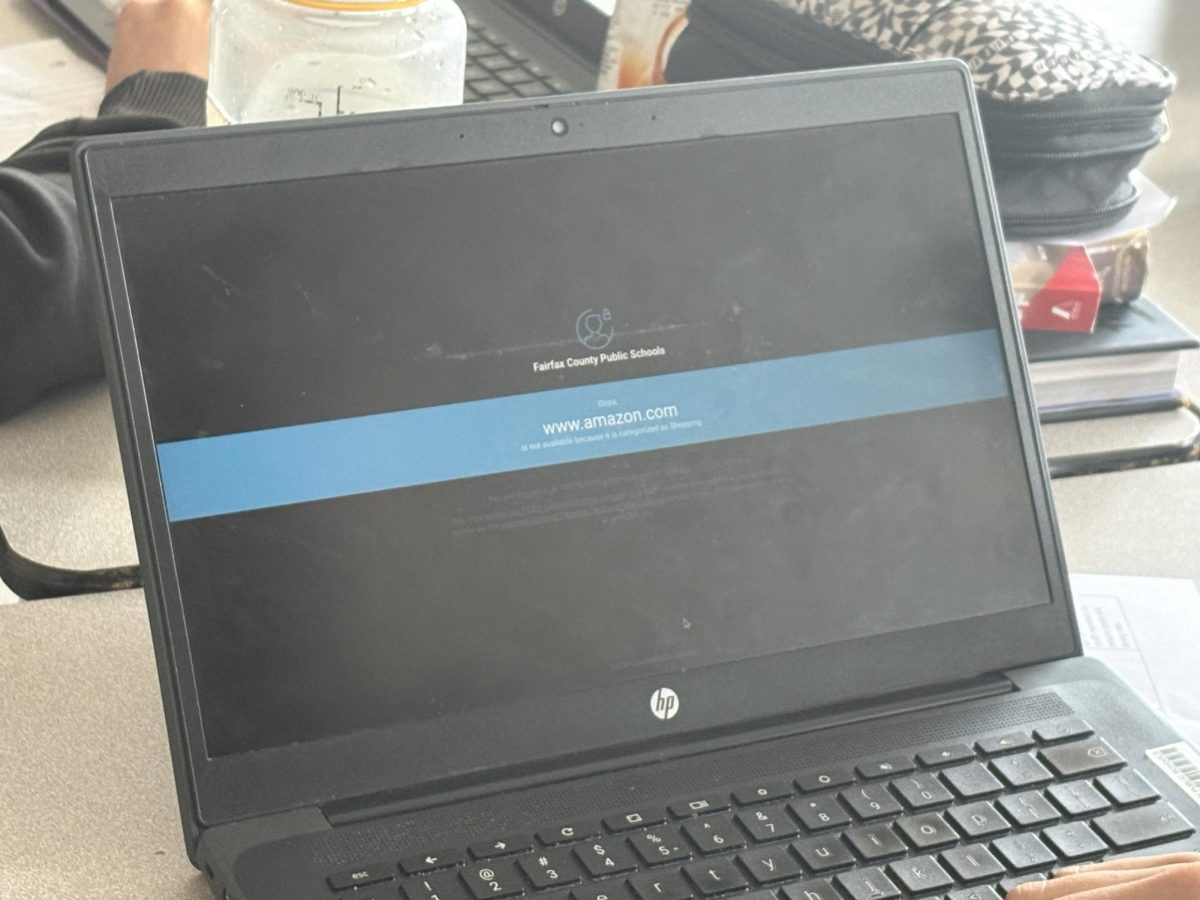
Metal Detectors, new grading policies, a mandatory academic support block and a changed cell phone policy have been implemented for the 2025-26 school year to address problems from the previous school year and comply with state guidelines. These early school year adjustments may give some seniors deja vu as they’ve grown to expect new rules each year.
“Even though it’s frustrating and a bit confusing, I expect the school to change the rules every year,” Anna Harper (’26) said.
Metal Detectors
Fairfax County Public Schools now requires all middle and high schools to use metal detectors at entrances to enhance school safety. With three entrances with metal detectors, students must use only those doors to enter the building. All other doors are monitored by teachers to ensure students don’t open them for their friends, allowing them to avoid the metal detectors before school.
Due to the limited entrances, lines can build up in the morning, especially around 8 a.m. with the influx of students entering the building. Even small changes can cause the line to build up as students have to adjust.
“I left my car around eight, and they had changed the way people were taking their stuff out of their bags, so people were confused, and the line wrapped around the building by the door to the main gym,” Harper said. “It made me late to class, but my teacher wasn’t surprised, because I was not the first [person who was late].”
The screening process continues to be streamlined and morning line buildups have been reduced, as students are able to hold laptops above their heads–and thus above the metal detectors–instead of passing them off to teachers. This allows a constant flow of students to pass through without setting off the metal detectors.
“They’ve done a lot to make it faster, [and] it’s a lot better,” Sara Rivas (’28) said.
To accommodate the addition of metal detectors, security guards, counselors and teachers staff the metal detector entrances each morning. Several teachers with morning free periods are required to help with the process.
“I’m not missing official planning time because I’m done when block one starts, but it is time that I could use productively,” English teacher Benjamin Eckman said. “It is hectic in the mornings as students are coming in and some days it can be exhausting.”
Because staffing the metal detectors can be tiring, he’s concerned that he may have to do it for the entire school year and not just the first quarter. Though it may be an extra obstacle in the morning, there are benefits.
“Every student gets a greeting when they come into the building,” Eckman said. “From a community standpoint, that’s an upside.”
Students remove binders, laptops and spiral notebooks from their bags to avoid setting off the metal detectors. After passing through, many crowd around tables to put items back in their backpacks.
“It’s crowded, slow and honestly a bit overwhelming when you’re just trying to start your day,” Sofia Hashim (’28) said.
Despite significantly emptier backpacks, students seem to set off metal detectors at random. When this happens, students are directed to pass through the metal detector again, and most of the time, they don’t set it off the second time. If they do, their bags are subject to search. This can be time consuming and may feel like a hassle to some.
“You have to take everything out to go through,” Joey Petrucelli (’27) said. “If someone were to walk into the school with a gun, the metal detectors aren’t going to stop them.”
Rivas, however, doesn’t agree.
“I’d rather have the metal detectors than weapons in school,” Rivas said.
Grading System
With the addition of a homework category to the gradebook and changes to reassessment policies, students are met with another seemingly yearly grading policy change.
With this change in the reassessment and grade replacement policy, doing well on the first attempt becomes more important as reassessments only replace previous grades up to 90%.
“I don’t necessarily like it, but I think it makes sense as a sort of penalty for not studying enough the first time,” Sophia Anderson (’29) said.
Additionally, students must have completed all of their formative assignments on time to be eligible for grade replacement. This can encourage students to complete their formatives, which often leads to better assessment performance.
“The addition of formatives helps support more positive behaviors in learning,” social studies teacher Kelly Field said.
In addition to previous year’s summative and formative categories, a homework section worth 5% of students’ final grade has been added to the gradebook. Also, county policy prevents teachers from assigning more than 30 minutes of homework per class period. In previous years, some classes didn’t assign homework, but now it is required. The definition of homework can depend on the teacher and subject. In some classes, the homework category is used for actual homework assignments, while other teachers use it for reading check scores or in class practices. With a lack of cohesiveness across classes and yearly grading system changes, it can be challenging for students to understand the system.
According to the FCPS Grading and Reporting Handbook, “homework should serve a positive purpose for learning and support the instructional program.”
Though the homework category is intended to encourage students to complete homework, it can also help raise the grades of students who already consistently do their homework.
“I was already doing my homework before, so I guess it’s nice,” Rivas said. “It’s worth 5% of your grade, so if you do your homework anyways, it’s just a boost in your grade.”
Similar to last year, teachers will review each student’s grade and remove the formative category if it lowers their overall grade at the end of the school year. Because of this, some students don’t worry about their formative grades or try as hard on formative assignments.
“If they get dropped at the end of the year, they don’t really matter,” Petrucelli said.
To other students, they serve as preparation for summatives and their impact, although small, still matters.
“I try to study for them because I know I won’t be able to retake them, but I try not to worry too much because they’re such a small percent of your grade,” Anderson said.
Though this year’s system may seem fairly similar to last year’s, the yearly changes to grading policies can make it difficult for students to adjust.
“The changes in the grading system every year are very difficult to keep up with, and I never fully understand it until halfway through the year,” Sean Clinton (’26) said.
Phone Policy
A state law was passed in April requiring students to keep phones away for the entire school day for the 2025-2026 school year. Intended to address student’s dependence on phones and their mental health effects, it requires phones to be away from “bell-to-bell”.
At Madison, this means phones may only be used during lunch in the cafeteria and otherwise must be stored in backpacks or lockers. The policy requires increasingly severe consequences for each infraction including confiscation, referrals and loss of phone privileges.
“I don’t use my phone during school anyways, but the increase in consequences makes me less likely to bring it out,” Audrey Kapitan (’27) said.
With the looming threat discouraging phone use, students are only practicing self regulation to an extent. While they don’t use phones to avoid consequences, they aren’t necessarily learning to stay focused by choice.
“I feel like the phone policy is teaching kids to not discipline themselves with their phones which will harm them more in the future and in college,” Emma Simpson (’26) said.
While the future implications of students not learning to control their phone use can be questioned, the policy is intended to address current problems. It aims to eliminate distractions in school and prevent cheating.
“If people actually followed the phone policy, it would keep them focused, but no one actually follows it,” Emily Linegang (’28) said.
Because writing referrals can take a lot of time, some teachers try to avoid it by warning students to get off their phones instead of immediately implementing consequences.
“The consequences are great for keeping people off of their phones, but many teachers don’t want to write kids up for being on their phones,” Kapitan said.
Erin Lo (’26) reminisces about last year’s phone policy that had students place phones in cell hotels and allowed them to use them between classes.
“I liked last year because if you needed your phone, the teacher would let you because it wasn’t illegal,” Lo said. “I was more focused and was able to multitask better.”
Without access to phones, students can’t verify accounts through texts, communicate with family and utilize some digital tools. Plus, with phones stored in backpacks, it’s easier for students to use them during class, compared to when they were stored in cell phone hotels.
In one of Lo’s classes, her teacher allowed them to use their phones for some time.
“My teacher was fine with us being on our phones until another teacher told him to start enforcing the policy, so he took a bunch of people’s phones randomly,” Lo said.
For some, being told no increases their desire for phone access.
“Now the urge of saying you can’t use it at all makes people want to use phones more,” Lo said.
Warhawk Time
As the bell rings for Warhawk Time, students are now required to go to one of their teacher’s classes for the first 30 minutes instead of spending time in the cafeteria or library as they have in previous school years. The first half of Warhawk Time has been renamed Support Block and is a time for students to get help from teachers.
“Support block is understandable, because that should be a time where you can go see your teachers and should be required to go get help when you need it,” Cait Englehardt (’28) said.
If students are only allowed in their teachers’ classrooms, then they may be more productive. Despite this, students can still be found wandering the halls, in other teachers’ classrooms and in other prohibited locations during Support Block.
“I think the support block change will do little to nothing due to the fact that it just won’t be enforced,” Hart said.
If students don’t respect Support Block and its rules are not enforced, it may be no different from previous year’s Warhawk Time One. Students who have always used 4th period for studying and getting help from teachers aren’t impacted by the change.
“I spend my time the same way I did last year,” Leanna Leung (’26) said.
Teachers are able to request for students to attend their support blocks, but outside of that, the changes have been minimal.
“I haven’t noticed a change in students’ behavior with the addition of Support Block,” said Field.
Admittedly, she exclusively teaches AP classes and her students frequently get help during 4th period without being required to. A bigger impact of Support Block is that it prevents clubs from meeting during the first part of Warhawk Time. In previous years, Book Club met in the library during Warhawk Time one, but now is required to meet after Support Block.
“[It] isn’t changing our club too much because we meet for one Warhawk Time period,” Simpson said. “However, I felt as if it was better to have [meetings] during the first Warhawk Time.”
Meeting during the first Warhawk Time helped Simpson avoid rushing meetings and gave her more time to set up and clean up.
While the move to include a support block may not influence student’s daily lives significantly, it is an additional restriction that may be unwanted.
“All this does is restrict the already-limited choices,” Areli Peralta (’28) said.