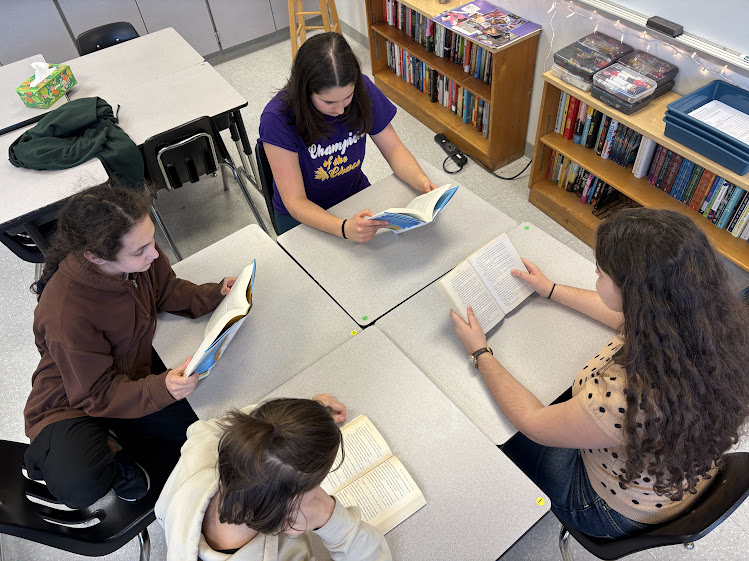
Ninth grade advisories introduced a new block of sustained silent reading (SSR) beginning September 22, in which students read a book of their choosing for the first 15 minutes of every advisory class. The goal of the program is to encourage students to keep reading, since many read less over the course of high school as schedules become more demanding. This means that students are increasingly missing out on many of the benefits of reading consistently, such as longer attention spans and a wider vocabulary.
“SSR in advisory helps me grow and excel as a reader even if it’s just fifteen minutes every other day,” Emerson Moseley (’29) said.
The idea for sustained silent reading was originally posed by librarians Liz Liebman and Megan McKnight as a solution to problems surrounding reading at Madison. Library check-outs have been declining since the pandemic, and on a national level, reading skills among students have worsened, with some students arriving at colleges unequipped to read full novels in their classes. Data from the 2024 National Assessment of Educational Progress (NAEP) shows that twelfth-grade reading skills have declined since 2019 in all but the highest percentiles.
“With those two factors in mind—we know that we have data showing that students, at least from this library, are not checking out books, and we know that students are leaving high school unprepared for the rigors of a four year university—we wanted to start this program and give students, honestly, the gift of time,” McKnight said. “To read for fifteen minutes every black day at the beginning of advisory in the hopes that it would build a reading habit.”
Principal Liz Calvert approved the idea, and then Liebman and McKnight told the ninth grade advisory teachers about the program.
“We wanted their encouragement and excitement for the program,” Liebman said.
In late September, all of the ninth grade advisories were invited to the library for book checkouts so that they would be ready for the day SSR began. The success of the program has varied between advisory classes, with some showing very promising results.
“Kids are actually asking to go to the library to get a book that they enjoy, and I think once they realize that reading doesn’t have to be something they’re forced to do, then it becomes something they want to do,” Maxine Walsh, a ninth grade advisory teacher, said.
Many students have found SSR to be a good opportunity to read without distractions.
“It allows a quiet time for me to just focus on reading with nothing else going on,” Everett Woods (’29) said.
However, for some students, SSR can be an annoyance.
“I’m not a big fan because I read in my free time and look forward to getting work done during advisory,” Ella Yazdani (’29) said.
At the same time, advisory is often busy and adding another required task can create difficulties with scheduling, since the period is already so short. Some students feel that they are missing out on time to complete homework, for instance.
“It’s proven to be a little challenging sometimes with scheduling,” Sarah Payne, another ninth grade advisory teacher, said. If we have mentors or, you know, other tasks to complete in advisory, it can impact the time that we’re reading, but overall it’s been a good experience.”.
While losing advisory time can be difficult, more time spent reading is beneficial for students. The program is intended to foster a reading habit that will continue throughout all four years of high school.
“It’s good for your brain,” Liebman said.