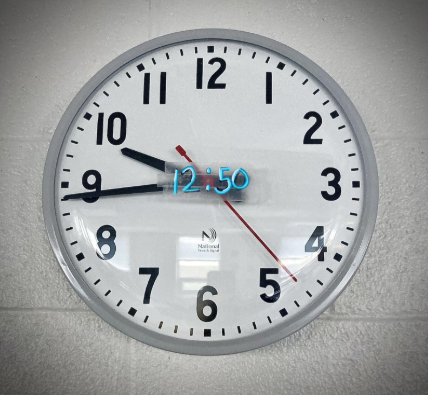
Inaccurate clocks have become an increasingly common issue as students rely on them more than ever. Since phones are now banned in Fairfax County Public Schools, previously obsolete analog clocks are receiving a lot more attention. With the need for accurate clocks on the rise, students have been noticing inaccuracies on a more regular basis.
One place this need can be seen is throughout the halls.
“[During passing periods] you don’t know if you’re going to be late because you don’t know what time it is, and you can’t check your phone,” Caroline Eich (’28) said.
Across eight classrooms, the typical analog clock was one minute behind. While most clocks fall into this category, the extremes of this data set include being an hour or even three hours behind standard time. There are two types of clocks around the school: hard-wired and battery-operated. Hard-wired clocks follow the time changes, so when there is a power outage, they fall behind. Battery-operated clocks don’t have this issue; however, they don’t automatically change for daylight saving time. With different clocks being impacted by different events, accuracy can be difficult to maintain.
“When I use the bathroom, I check the clocks to make sure when I go, I have enough time to get back before the bell rings,” Yiming Chen (’26) said. “Except sometimes I miss it completely because [the clocks] are out of sync.”
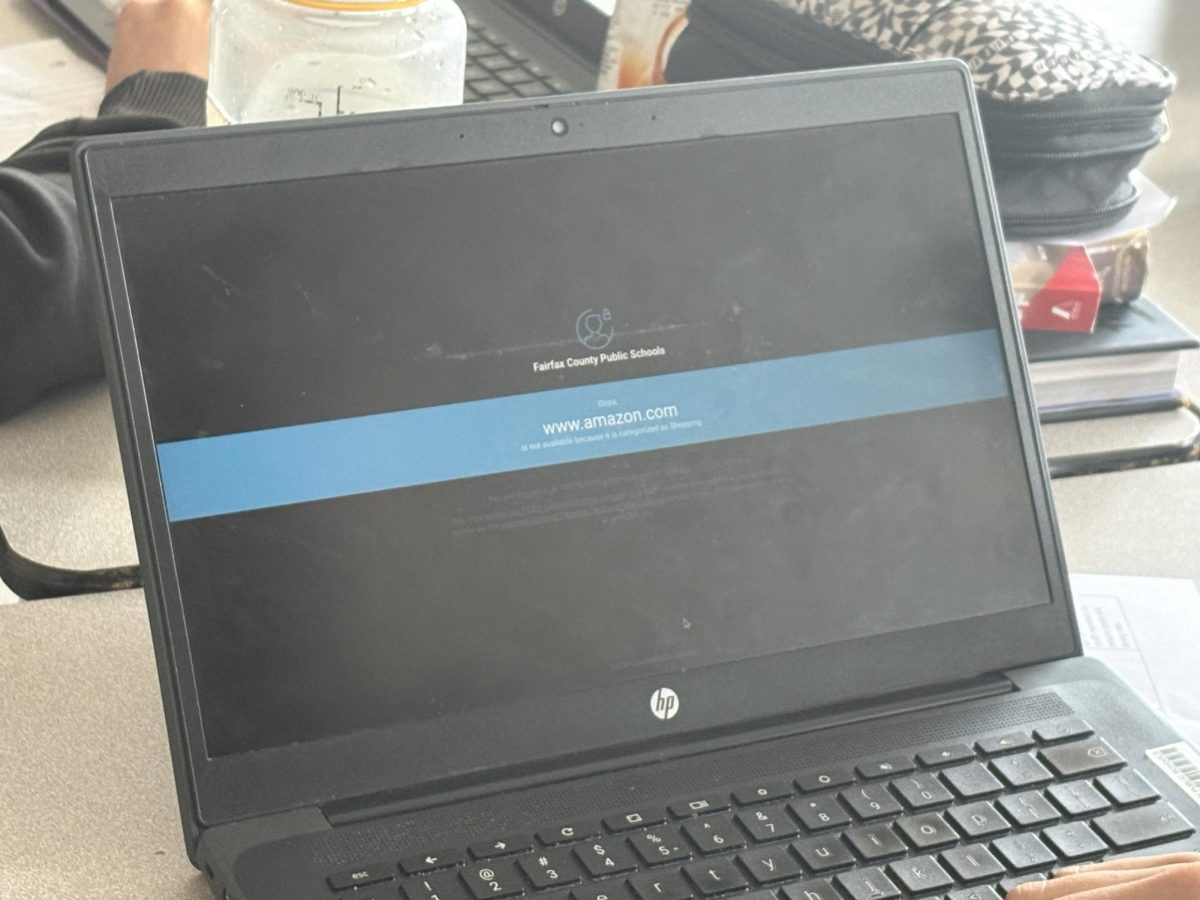
In contrast, when students have access to their laptops, some find that there is not as much of a need to rely on the clocks inside classrooms. Having to leave a class early tends to vary in difficulty based on the class and how often computers are in use. Luckily, many courses use computers at some point within the ninety minute block, allowing students to more readily keep track of the time.
“If my parents are taking me out [of class early] because I have somewhere important to be, I can just see the time on my computer,” Morgan Kosar-Gidda (’26) said.
To further the efforts towards clock accountability, teachers have begun to adapt. While tweaking the clocks is easy with the assistance of a tall individual, some teachers opt for a different style of clock altogether. Many students do not have a lot of experience with analog clocks, leading to gaps in clock-reading proficiency. Furthermore, when students have a difficult time reading the clocks, they are unable to accurately sign in and out of class. This can prevent teachers from knowing when a student leaves their class and for how long.
“Both Ms. Padgett and I put [a digital clock] on our parent wishlists,” math teacher Melissa Walsh said. “That has helped tremendously because it can be frustrating when [students] are unable to read the clock and need to sign out [of class].”
Since the different types of clocks are impacted by different events, faculty often cannot rely on a routine. A few clocks here and there are bound to be overlooked, which is why Director of Student Activities Andrew Baird suggests notifying the Student Activity Office about long-term inaccuracies.
“It might not seem that important that the clocks are off by a couple of minutes, but with our students not having access to their phones, it makes it [even] more important to ensure those clocks are [reliable],” Baird said.