
Chemistry Honors students competed in the regional science fair on March 13 through 15 for a chance to advance to the state science fair.
From the first week of school through late January, Chemistry Honors students dedicated hours to their science fair projects. In September, they brainstormed topic ideas and submitted their ideas for approval. After that, the students created and submitted a research plan to be approved in October. In November and December, students conducted their experiments with many rounds of trials to get data. In January, students processed and analyzed their data to determine a conclusion and created their boards that showcase all of their hard work. On Jan. 22, students competed in the school-wide science fair and presented to several judges each.
A few days after presenting their projects, students from the top three in each category were nominated to advance to the regional science fair. Benjamin Gummer (’28), Sasha Rockman (’28) and Noah Nam (’28) are three of the students who competed at regionals this year.
Gummer won first place at Madison in the Earth & Environmental Sciences category for his project about the effect of turf pellets on water quality.
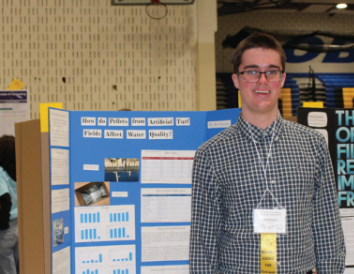
“I had to gather the pellets from the field, clean them, and then test them at the Fairfax Water Lab,” said Gummer.
Gummer conducted a variety of experiments to test if the water was affected at all by the turf pellets. Because he used the resources at the Fairfax Water Lab, the staff gave him detailed training which made the experimentation fairly easy for Gummer. He found the analysis of the data to be the hardest part and had to learn many techniques and methods of calculation to process the data.
“The pellets from the turf fields don’t affect the water quality,” Gummer said. “This means that turf fields are safe to play on, at least based on their impact on water quality.”
Rockman won first place at Madison and regionals in the chemistry category for her project about the age of plumbing systems in homes and how it affects the amount of pollutants in the water.
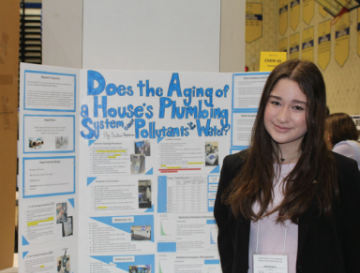
Rockman collected water samples from nine different houses and tested for bacteria in the water as well as turbidity, phosphate, and chlorine levels. After that, she compared the data to the age of the house’s plumbing system to determine if there was a correlation between them.
Rockman did not find a significant correlation between the age of plumbing systems and the amount of pollutants in the water, but instead found a different correlation.
“I found that houses with strong modern filters harmed the water…I found dangerously high levels of phosphate in those houses because there was a relatively low amount of chlorine,” said Rockman.
Nam placed in the top three at Madison in the systems software category for his project, in which he built an AI model to predict the biological age of skin. However, before Nam could even start his project, he had to learn how to code and build an AI model.
“The actual coding didn’t take very long, but I had to learn to code, which took a little while,” said Nam.
After that, Nam trained the AI on pictures of hands so it could learn how to identify the age of skin based on photos alone. When that was done, Nam ran many trials on various pictures of hands and found that the average error was 1.6 years.
“I think the hardest thing was turning the data into something useful…and it took a really long time,” said Nam.
After three days of project presentations, of the 22 projects selected to represent Madison, one project won a grand prize, two projects won grand prize alternates and eight projects won first place in their categories.
“I am really proud of all the students who participated,” Chemistry teacher Carol Dalmet said. “It was a great positive experience for them and I am also thankful to all the mentors who helped them because without the mentors, it would not have been possible.”